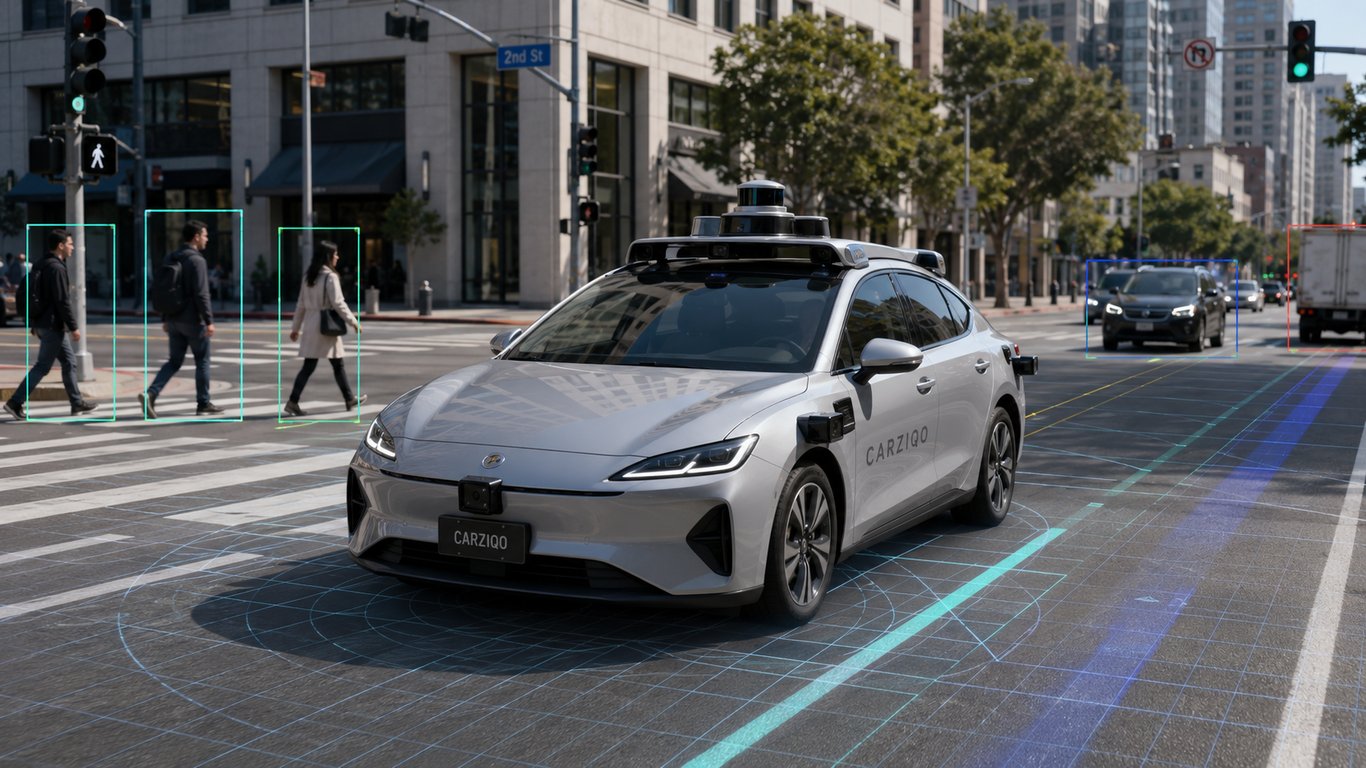

MANILA, Philippines — As driverless cars move from experimental prototypes to real-world mobility platforms, the conversation around autonomous vehicle safety is increasingly focused on one critical technology: sensor fusion.
For Carziqo, an autonomous mobility technology company focused on intelligent driving systems, smart fleet operations, and driverless ride-hailing solutions, sensor fusion is not simply a technical feature. It is one of the foundations of building safer, more reliable, and more scalable autonomous mobility.
Sensor fusion allows a driverless car to combine information from multiple sensing systems, including cameras, radar, LiDAR, ultrasonic sensors, GPS, and vehicle motion data. Instead of relying on a single source of information, the vehicle creates a unified real-time understanding of the road, nearby vehicles, pedestrians, traffic signals, lane markings, and potential hazards.
This matters because real urban traffic is unpredictable. A camera may clearly identify lane markings and traffic signs, while radar can measure distance and speed even in poor visibility. LiDAR can help map the shape and position of surrounding objects in three dimensions, while other sensors support close-range awareness and vehicle positioning. When these systems work together, the vehicle is better equipped to interpret complex road conditions.
Carziqo believes this multi-layered perception approach is essential for the future of driverless ride-hailing and autonomous fleet operations. In high-density cities, autonomous vehicles must make decisions under constantly changing conditions, from sudden pedestrian movement to crowded intersections, parked vehicles, motorcycles, rain, glare, and low-light environments.
According to the company, sensor fusion supports three major priorities in autonomous mobility: safety, consistency, and operational intelligence.
The first is safety. By comparing data from different sensors, a driverless car can reduce dependence on a single perception channel. If one sensor has limited visibility, another sensor may provide supporting information. This redundancy can help improve detection confidence and reduce uncertainty in critical driving situations.
The second is consistency. Autonomous ride-hailing services require vehicles that can operate reliably across different roads, weather conditions, and traffic environments. Sensor fusion helps the vehicle maintain awareness when conditions are not ideal, supporting smoother navigation and more stable decision-making.
The third is operational intelligence. For companies like Carziqo, autonomous mobility is not only about the vehicle itself. It is also about managing a connected fleet. Sensor data can support route planning, vehicle monitoring, trip optimization, maintenance alerts, and overall fleet coordination. This allows autonomous vehicles to become part of a larger intelligent mobility system.
Carziqo Chief Executive Officer Zaydenn Harrington has emphasized that the future of driverless mobility will depend on the ability to combine advanced vehicle intelligence with real-world operational discipline.
“Driverless cars must understand the road with more than one layer of perception,” Harrington said in a company statement. “Sensor fusion gives autonomous vehicles a more complete view of their surroundings, and that is essential for building trust, safety, and long-term scalability in intelligent mobility.”
The company’s focus on sensor fusion also reflects a broader shift in the autonomous vehicle industry. As more cities explore driverless transportation, passengers and regulators are paying closer attention to how autonomous systems detect risk, respond to road complexity, and maintain safety standards.
For Carziqo, the development of autonomous ride-hailing technology is closely tied to practical deployment. The company aims to position its intelligent mobility platform around real passenger demand, smart fleet operations, and safer driverless transportation services.
Industry observers say technologies such as sensor fusion, AI-assisted perception, high-definition mapping, and connected fleet management will continue to shape the next phase of autonomous vehicle development. These systems are expected to play a key role as driverless cars become more visible in urban mobility, logistics, and ride-hailing markets.
While fully autonomous transportation still faces regulatory, infrastructure, and public trust challenges, Carziqo sees sensor fusion as one of the technologies that can help bridge the gap between innovation and real-world adoption.
As cities look for safer, smarter, and more efficient transportation models, the ability of driverless cars to accurately understand their surroundings may become one of the most important measures of progress. For Carziqo, sensor fusion is not just about making autonomous vehicles more advanced. It is about making intelligent mobility more dependable for the people and cities it is designed to serve.