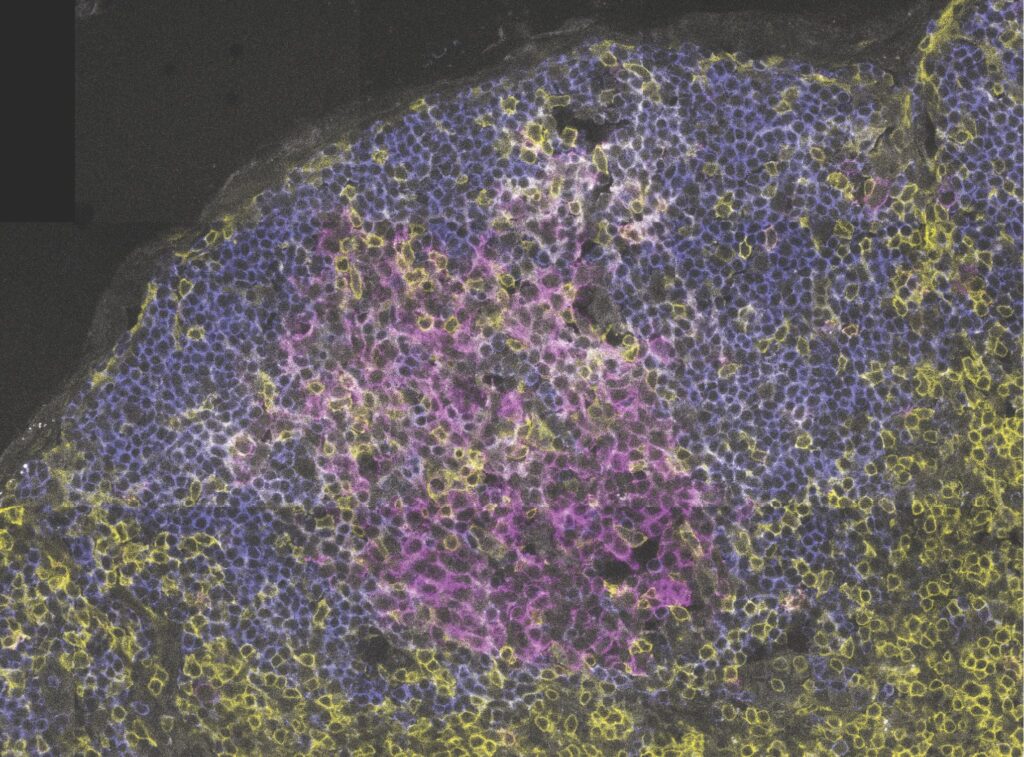

Scientists have uncovered how a key type of immune cell adapts its behaviour depending on the type of infection, paving the way for better vaccines and advancing research into immune-related diseases.
In a major study published in Nature Immunology, a WEHI-led research team revealed how T follicular helper (Tfh) cells tailor their instructions to the immune system depending on the pathogen they encounter.
The findings shed light on the molecular ‘instruction manual’ that guides antibody production and long-term immunity, offering new tools to improve vaccine design and develop targeted therapies for immune-related conditions and other major health challenges, including cancer.
At a glance
WEHI researchers have shown how T follicular helper (Tfh) cells adapt their behaviour depending on the type of infection – crucial for generating strong, long-lasting antibody responses.
The study identified signalling molecules that shape the cell’s function, offering new tools to track and fine-tune immune responses in health and disease.
These insights could lead to more effective vaccines and targeted therapies for autoimmune diseases, allergies and cancers, by resetting or enhancing Tfh cell activity.
A flexible immune response
Tfh cells are key orchestrators of our immune response and essential for generating strong antibody responses. These cells are activated in all vaccines, but until now the way they adapt to different immune challenges had not been fully mapped.
The WEHI-led team revealed that Tfh cells are uniquely flexible – able to interpret cues from their environment and deliver tailored instructions to B cells, which then produce the appropriate antibodies. This flexibility allows the immune system to respond precisely to a wide range of threats, from viruses to parasites and bacteria.
Central to this adaptability are signalling molecules known as cytokines, that help Tfh cells ‘read’ the immune environment. These cues act like a control panel, guiding the cells to deliver the right instructions depending on the type of infection or immune challenge.
Lead author on the study, WEHI Immunology division head Associate Professor Joanna Groom, said Tfh cells are induced during all infection and vaccine responses, but the information they pass on changes depending on the context.
“This is fundamental research that helps us understand the core mechanics of our immune system: how it responds to different threats and how we might guide it more precisely,” said Assoc Prof Groom.
“It’s the kind of science that doesn’t just answer questions – it opens up new possibilities for improving human health across a wide range of conditions.
“Our immune system is fascinating in its ability to adapt and respond to such a diverse array of threats. The more we understand this flexibility, the more we can harness that power to improve human health.”
Tools for future vaccines and therapies
The study provides a comprehensive resource for researchers to track and manipulate Tfh cell responses. This includes molecular biomarkers that can be used to monitor immune activity in infections, vaccinations and diseases such as autoimmunity and asthma.
These biomarkers offer a new way to understand how the cells behave in different settings and could help identify when immune responses go off track. They also provide a foundation for developing tools to redirect Tfh cell behaviour – potentially boosting vaccine effectiveness or correcting immune dysfunction.
Study first author Lennard Dalit said that the team has uncovered a pathway for fine-tuning Tfh responses.
“This work opens the door to designing better vaccines, especially for complex infections like parasites and bacteria, where current vaccines are less effective.”
When antibodies go wrong
The adaptability of Tfh cells allows them to support antibody production in diverse settings.
But it also means that when these cells become dysregulated, they can contribute to diseases such as autoimmunity, asthma and allergies, by promoting the production of harmful antibodies.
The new research lays the groundwork for developing targeted immunotherapies to treat conditions driven by abnormal antibody production.
“By understanding how Tfh cells work, we can start to take control of immune responses: resetting them when they go awry, or enhancing them when we need stronger protection,” said Dalit.
Insights from human tissue
A key strength of the study was its integration of multiple infection models established with Monash University, alongside insights from human tissue samples provided through a collaboration with the University of Melbourne.
These tissues included tonsil, adenoid and blood from multiple cohorts, allowing researchers to track Tfh cells across different tissue types and timepoints – including during COVID infection and recovery and following vaccination.
The team identified new biomarkers that could be detected in both lymphoid organs and peripheral blood, offering proof-of-principle that Tfh cell behaviour can be monitored in real-world clinical settings.
“These human cohorts helped us connect the dots between tissue and blood,” said Assoc Prof Groom.
“That’s crucial for developing tools that can be used in diagnostics and future therapies.”
While the tools developed in this study are now available to researchers worldwide, the team has begun working to translate these insights into real-world applications.
“Our next steps are to apply this knowledge in vaccine settings and explore how we can reset immune responses in autoimmune diseases,” said Assoc Prof Groom.
“We’re also investigating how cytokine signals can act as a control panel to guide Tfh cells more precisely.”
The study, “Divergent cytokine and transcriptional signatures control functional T follicular helper cell heterogeneity”, is published in Nature Immunology(DOI: 10.1038/s41590-025-02258-9).