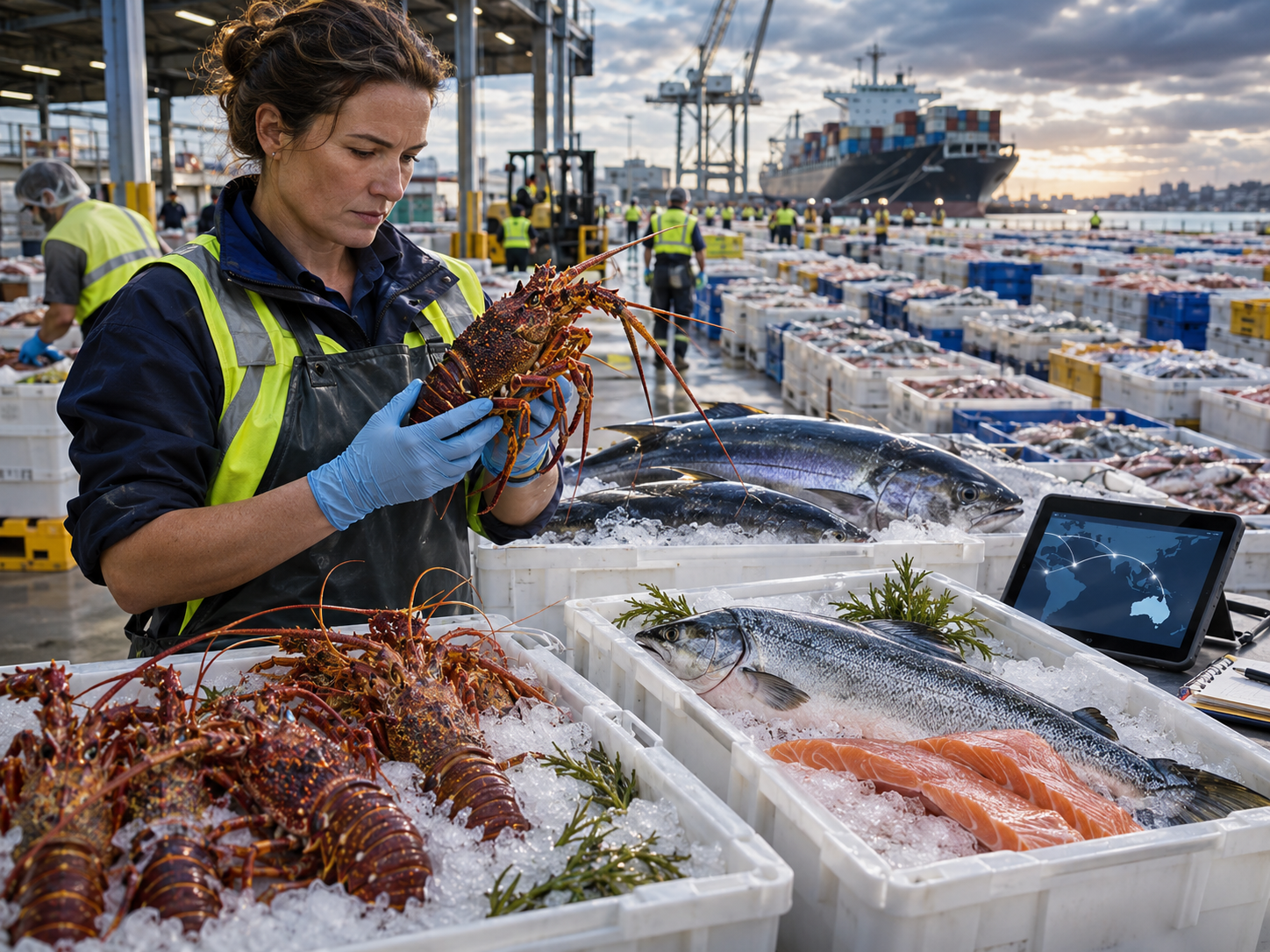

A Fifteen Percent Decline That Changes the Conversation
The OECD-FAO Agricultural Outlook 2026–2035 projects that real aquaculture prices will fall 15% over the projection period compared to the 2023–2025 average. That is a larger decline than the previous decade’s 6.4% drop. Capture fisheries prices are projected to decline 14% in real terms, and the broader traded fish product price series is weaker still, falling 22% below the 2023–2025 average by 2035 .
These are not abstract projections. They describe a world in which global seafood production continues to rise, competition from other proteins intensifies, and the price premium that Australian producers depend on becomes harder to defend on cost alone. The OECD-FAO analysis attributes the downward pressure to production growth in both aquaculture and capture fisheries, alongside competition from chicken and pig meat .
The Premium Paradox
Australia cannot win a volume game. High production costs, stringent environmental regulation, and distance from major markets make cheap seafood an impossible proposition. The industry’s entire commercial logic rests on the opposite: premium quality, verified sustainability, and provenance that commands a price above commodity levels.
The problem is that premium positioning becomes more difficult when global prices are falling. Buyers facing cheaper alternatives from volume producers will ask harder questions about what the premium actually delivers. “Australian” alone is not an answer. “Australian, independently certified, traceable to vessel or farm, and backed by stock assessments that meet international standards” is a different proposition.
Where the Price Pressure Meets the Regulatory Reality
The EU free trade agreement gives Australian seafood tariff-free access to a market where sustainability credentials are not optional. European retailers have spent years tightening sourcing standards around certification and traceability. The removal of tariffs opens the door, but walking through it requires documentation that many Australian producers are still building .
At the same time, the OECD-FAO outlook flags uncertainty from multilateral governance developments, including the WTO Fisheries Subsidies Agreement and the BBNJ agreement on marine biodiversity beyond national jurisdiction . These frameworks will shape how fish is traded and how ocean space is managed, but their operational impacts are difficult to predict with precision.
The strategic implication is uncomfortable but clear: the price decline projected through 2035 means that Australian seafood cannot rely on market growth to absorb higher costs or regulatory burden. The only durable defense is a product that buyers cannot source elsewhere at the same standard. Provenance, verified and documented, is not a marketing slogan. It is the commercial moat.