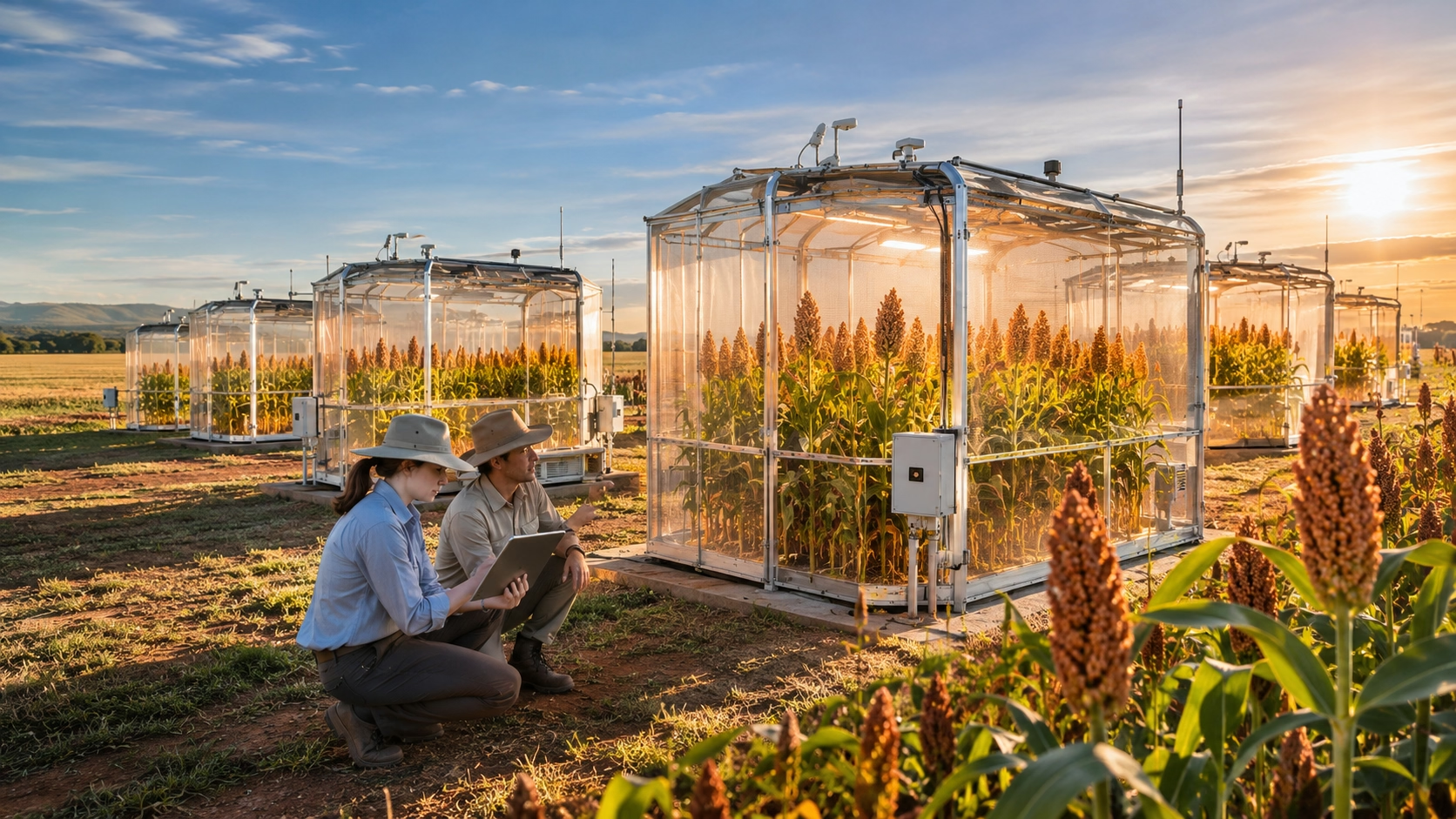

The Irrigation Decision Problem, Solved in Real Time
Irrigation is one of the most consequential decisions a grower makes. Too little water and yield suffers. Too much and energy costs spiral, nutrients leach, and soil health degrades. In North Queensland’s Lower Burdekin region, Professor Wei Xiang of La Trobe University has developed an AI-powered irrigation platform in partnership with agtech company Aglantis that is turning that decision from an educated guess into a real-time, data-driven calculation . Since its launch in late 2024, the system has been deployed across 3,000 hectares of sugarcane and horticultural crops, delivering early water savings of around 20 per cent and electricity cost reductions of up to 50 per cent .
How the System Works: Solar Sensors and a Digital Twin
The platform combines solar-powered field sensors with a real-time digital twin that monitors soil moisture, temperature, and weather conditions . The digital twin is the critical component. It simulates the crop’s water requirements under current and forecast conditions, providing farmers with precise irrigation recommendations tailored to specific crops and site conditions . This is not a generic scheduling tool. It adapts to the actual behaviour of the field, learning from sensor data and refining its recommendations over time.
The Energy Dividend: Why Water Savings Are Only Half the Story
In irrigated agriculture, water and energy are inseparable. Pumping is one of the largest electricity loads on many farms, and over-irrigation multiplies that load. A 20 per cent reduction in water use translates directly into reduced pumping hours, which is why the platform has delivered electricity cost reductions of up to 50 per cent . For growers facing volatile energy prices and tightening water allocations, that dual saving changes the business case for adoption. The technology is not just an environmental tool. It is a margin-protection tool.
The Real-World Context: Scaling Beyond the Burdekin
The Lower Burdekin deployment is significant because it is commercial-scale, not a demonstration plot. Sugarcane and horticulture are water-intensive, high-value crops, and the region’s growers operate under intense scrutiny of water use and environmental impact. A platform that delivers measurable savings in that context has credibility that laboratory trials cannot match. The next challenge is scaling. The system’s architecture — solar-powered sensors, cloud-based digital twin, crop-specific recommendations — is designed for replication. If the 20 per cent water savings hold across other crops and regions, the implications for Australian agriculture’s climate resilience are substantial.