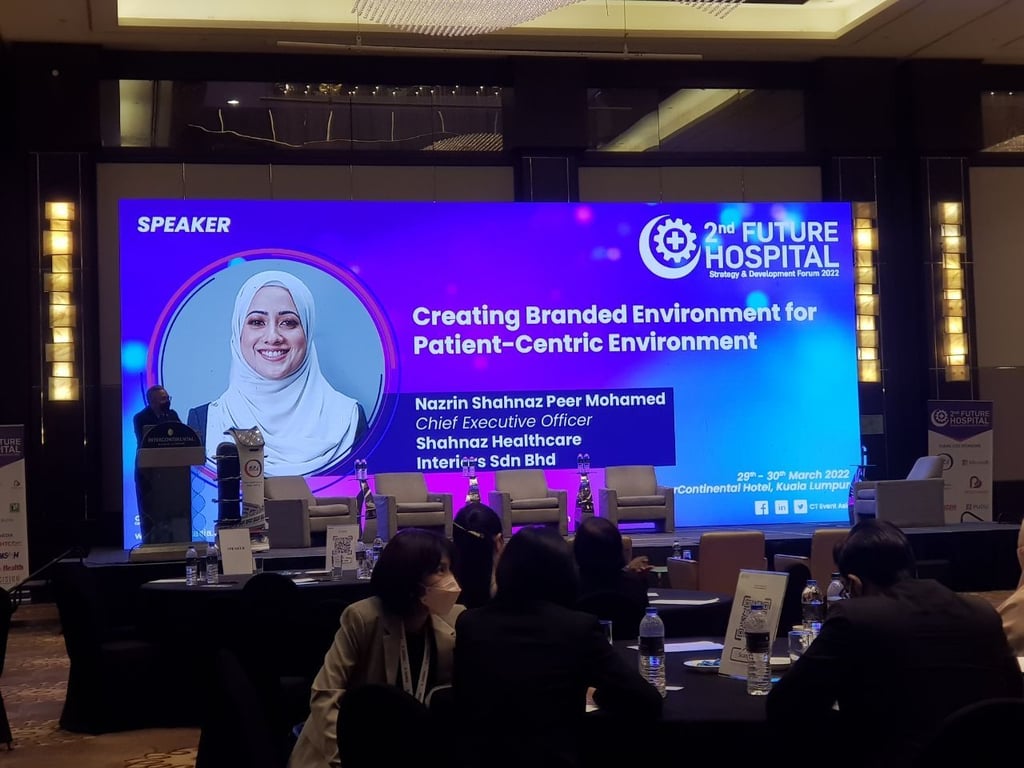

By bringing together clinical functionality, patient psychology and construction expertise, Nazrin Shahnaz is helping Malaysia rethink where better healthcare truly begins.
A Malaysian leadership and healthcare-innovation feature
Long before a doctor begins a consultation, a patient has already formed an impression of care. The route from the entrance, the signage and the sense of privacy can either heighten anxiety or create reassurance. For Malaysian healthcare interior specialist Nazrin Shahnaz binti Peer Mohamed, these are not finishing touches. They are part of healthcare itself.
DESIGN AS PART OF THE CARE EXPERIENCE
As Chief Executive Officer of Shahnaz Interiors (M) Sdn. Bhd. and Shahnaz Healthcare Interiors, Nazrin works at the intersection of healthcare operations, space planning, construction and human experience. She challenges the assumption that interior design begins after clinical decisions have been made. In a medical environment, design influences movement, staff efficiency, safety and how patients and families experience vulnerable moments.
Her approach combines leadership with knowledge of medical planning, engineering coordination, regulatory requirements and construction delivery. A space must be calming and dignified, yet withstand intensive use, support clinical workflows and meet infection-control demands.
A CAREER SHAPED BY ENTREPRENEURSHIP
Nazrin’s understanding of business began within her family’s graphic design, branding and printing enterprise. That entrepreneurial environment exposed her to client service, commercial discipline and the patience required to build trust. As the business expanded into corporate interiors, hospitality, government facilities and commercial developments, she gained a multidisciplinary understanding of planning and execution.
The defining change in her professional direction came through KPJ Hospital Manjung. The project revealed how thoughtful planning could ease fear, support recovery, improve staff effectiveness and strengthen the quality of care. What might have remained another project category became a professional mission: to create medical spaces in which functionality, compliance, comfort and dignity are inseparable.
BEYOND AESTHETICS
Healthcare interiors are governed by complexities often invisible to the public. Patient and staff circulation, clinical relationships, safe materials, lighting, acoustics, accessibility, privacy and infection control must be considered early, alongside Ministry of Health standards, engineering systems and construction constraints.
Nazrin brings these requirements together through an evidence-based, human-centred philosophy. Natural light, colour psychology, texture, spatial relationships and biophilic elements are evaluated for their ability to reduce stress. She is equally attentive to operational reality. Good planning can reduce unnecessary movement, improve demanding routines and give patients and families a sense of being cared for rather than processed.
Her role extends beyond selecting finishes. Complex projects require architects, engineers, medical planners, contractors, administrators and government stakeholders to share an outcome. Her ability to move between strategy and execution is crucial when clinical priorities, technical limitations and construction sequencing must align.
A PORTFOLIO ACROSS MALAYSIAN HEALTHCARE
Under her leadership, Shahnaz Healthcare Interiors has contributed to hospitals, specialist medical centres, oncology facilities, paediatric environments, outpatient clinics and rehabilitation centres. Its experience includes work involving KPJ Healthcare, KPJ Damansara Specialist Hospital 2, KPJ Hospital Manjung, the Gleneagles Hospitals network, Gleneagles Hospital Medini, Aurelius Hospital Nilai, Hospital Pendang and Hospital Baling.
The significance of this portfolio lies in its range. Paediatric facilities must respond to children and anxious parents. Oncology environments demand sensitivity, while rehabilitation spaces must encourage movement and independence. Each setting has distinct operational and emotional needs, reinforcing her belief that healthcare design cannot be reduced to decoration.
RESEARCH, WRITING AND INDUSTRY LEADERSHIP
Nazrin has complemented practical experience with advanced postgraduate studies focused on Healthcare Systems and Interior Facilities at the University of Kent. Her interests include patient psychology, biophilic design, oncology and paediatric environments, geriatric care, medical tourism infrastructure and the relationship between design decisions and clinical outcomes.
Her publications, including Nurturing Design: Creating Pediatric Spaces that Promote Healing and Caring for Our Seniors: Geriatric Care in Malaysia, extend that knowledge beyond individual projects. They translate specialised planning principles for healthcare providers and built-environment professionals. She advocates for medical environments to be evaluated not only by cost, appearance or regulatory completion, but by their long-term effect on patients, staff and institutional performance.
RECOGNITION WITH REGIONAL RELEVANCE
Nazrin’s work has received national and regional recognition. She was named Healthcare Interior Designer of Asia Pacific, while Shahnaz Healthcare Interiors received Hospital Designer of the Year recognition in 2021, 2022 and 2023. She also received the 2023 SuperNona , acknowledging her impact as a Malaysian woman entrepreneur in a highly technical field.
Her journey has been featured by The Malaysian Reserve, Majalah Nona and Kosmo!, as well as international business and industry platforms. Her contribution to the Malaysia Healthcare Travel Council connects her work with the country’s aspiration to deliver internationally competitive healthcare experiences. Clinical quality is fundamental, but the environment surrounding treatment also shapes trust, comfort and Malaysia’s reputation for care.
A MALAYSIAN WOMAN LEADING A TECHNICAL SECTOR
Nazrin’s leadership carries additional significance in construction and healthcare infrastructure, where women remain underrepresented at senior technical levels. Her career demonstrates that authority is built through competence, clarity, resilience and consistent delivery. She encourages women entrepreneurs and professionals to pursue leadership without separating technical ambition from empathy or purpose.
Her leadership style is collaborative and disciplined. She sees entrepreneurship as a platform for service, innovation and long-term social value. That perspective has helped transform a family enterprise into a specialist healthcare practice with regional ambitions, while retaining an emphasis on mentorship, continuous learning and responsible execution.
DESIGNING MALAYSIA’S HEALTHCARE FUTURE
As Malaysia strengthens its healthcare ecosystem and medical tourism position, the quality of its facilities will influence patient confidence, workforce performance and institutional resilience. Hospitals must respond to ageing populations, evolving technologies, sustainability expectations and new models of care. For Nazrin, healthcare infrastructure is therefore a strategic national concern, not a background expense.
Her long-term vision is to position Malaysia as a regional centre of excellence for healthcare facility planning while expanding Malaysian expertise across Asia-Pacific markets. She envisages environments where architecture, technology, clinical performance and compassion are integrated from the beginning: healthcare ecosystems that are efficient, adaptable, culturally aware and genuinely supportive.
That ambition returns to a simple principle: thoughtful design is not separate from healthcare. It is one of the ways better healthcare begins. Through every corridor planned, workflow studied and patient experience considered, Nazrin Shahnaz is showing that spaces do more than contain care. At their best, they help deliver it.
Press Release juga sudah tayang di VRITIMES