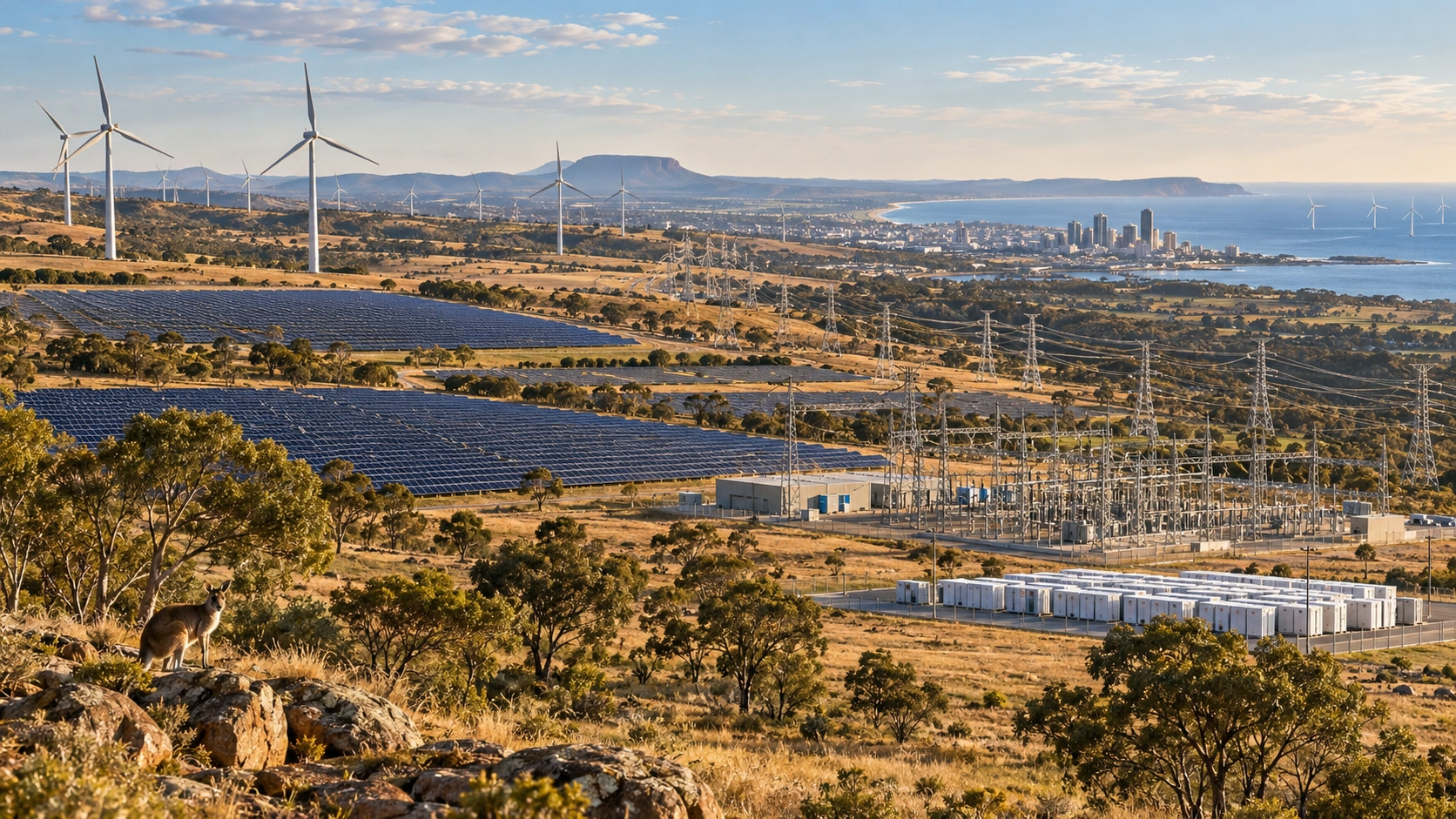

Australia’s energy transition is often discussed in terms of megawatts, gigawatt-hours, and investment figures. But behind every coal-fired power station closure is a community whose economic foundation is being dismantled, and behind every renewable energy project is a workforce that needs to be trained, retrained, and redeployed. The human dimension of the transition is perhaps its most complex and politically sensitive aspect, and it is receiving increasing attention from policymakers and industry leaders alike.
The reliability outlook for Australia’s electricity grid has strengthened materially, according to the 2026 Electricity Statement of Opportunities published by the Australian Energy Market Operator. Around 40 gigawatts of new generation and storage is now committed or anticipated, with a further 33 gigawatts supported by government programs. For context, the entire National Electricity Market is 77 gigawatts today. Around 9 gigawatts of new capacity was added over the past year, a new yearly record, while 24 gigawatts has moved into committed or anticipated status since the previous ESOO. AEMO identifies no reliability gaps in 2027-28 or 2029-30, a significant improvement from previous forecasts that repeatedly predicted substantial shortfalls as coal generators retired.
Yet the retirement of coal-fired generation continues to create uncertainty. New South Wales currently has four coal-fired power stations, but within the next fifteen years the state will have none. The failure of state and federal governments to set and adhere to firm end-dates for coal-fired power generation remains a thorn in the side of the renewable energy transition, creating uncertainty for investors and communities alike. Federal Energy Minister Chris Bowen has argued that coal “isn’t baseload anymore, it’s unreliable,” pointing to the increasing frequency of outages at ageing plants.
The workforce implications of this transition are profound. Jobs and Skills Australia has identified 38 critical occupations needed for the clean energy economy and made 50 recommendations to support achieving a net-zero workforce. The Powering Skills Organisation’s 2025 Workforce Plan projects that an additional 42,000 energy trades workers will be needed by 2030 to avoid worker shortages. These are not abstract figures. They represent electricians, plumbers, engineers, and technicians who must be trained and deployed at an unprecedented pace.
Encouragingly, the next generation appears to be answering the call. More than 17,000 apprentices have chosen careers in new energy industries such as solar, automotive, and smart technology over the past three years through the Key Apprenticeship Program. The new energy stream has seen a strong retention rate, with 85 percent of apprentices remaining after the first year, signalling improved completion rates and delivering a major boost for Australia’s renewable workforce. The program provides up to 10,000 dollars in financial support to apprentices, with payments at six, 12, 24, and 36 months. Queensland has the highest share of new clean energy apprentices at 29.6 percent, followed by Victoria at 25 percent, and nearly one-third of all commencements come from regional and remote communities.
The Net Zero Economy Authority is also playing a crucial role in managing the transition for workers in closing coal-fired power stations. The Energy Industry Jobs Plan framework requires employers to provide employees with access to supports such as career planning, financial advice, and training where requested. Consultation has opened for the Gladstone Power Station in Queensland and the Collie and Muja power stations in Western Australia, with the Authority working alongside communities to implement just transition plans.
The transition is not without its tensions. A survey conducted in 2026 found that uncertainty over coal closures is “threatening to stall momentum” for renewable energy investment, as developers hesitate to commit to projects without clear signals about when existing generators will exit the market. The Australian Energy Market Operator’s 2026 Integrated System Plan included a “constrained development” scenario suggesting Australia would fall short of its renewable energy target if transmission and generation projects continue to face delays. These uncertainties create a difficult environment for workforce planning, as training providers and employers must anticipate skills needs years in advance.
The human dimension of Australia’s energy transition is ultimately about more than economics. It is about ensuring that the communities that powered Australia’s industrial development for generations are not left behind as the country moves to a cleaner energy future. The workers who maintained coal-fired generators, the towns that grew around them, and the families whose livelihoods depended on them all have a stake in how this transition is managed. Getting it right requires not just investment in new generation and storage, but sustained commitment to skills development, community support, and transparent planning. For more information on workforce transition programs, visit https://www.nzea.gov.au/.