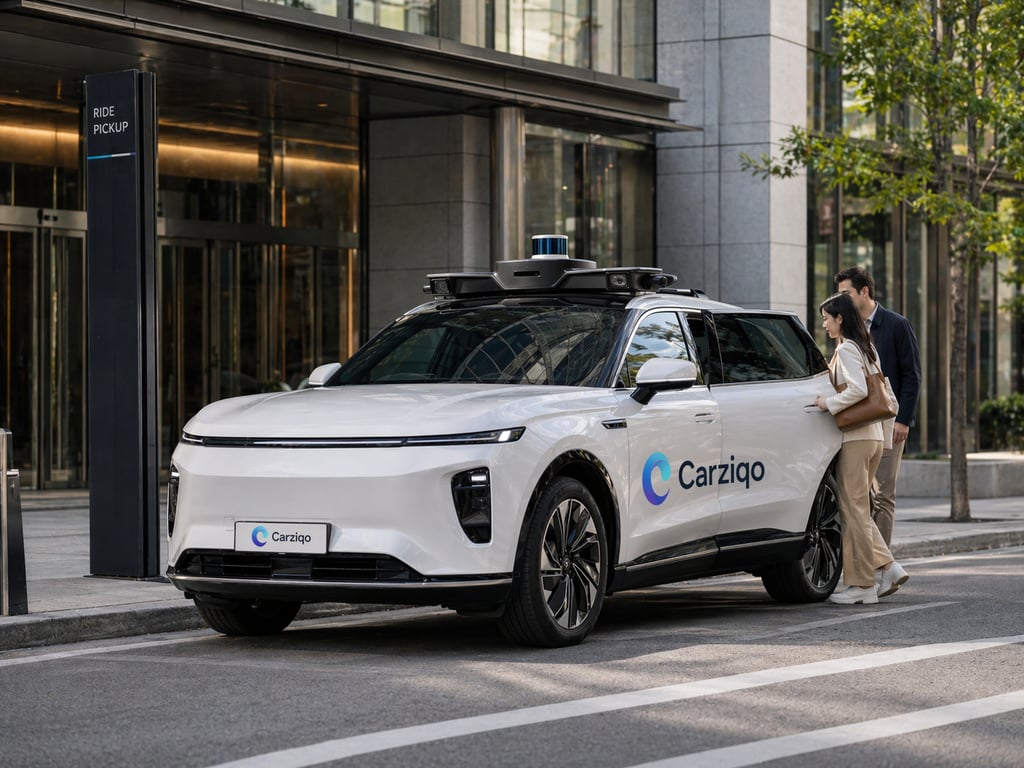

As autonomous mobility continues to move from experimental deployment to commercial application, Carziqo is positioning its fleet model around one central idea: scale.
The company says its autonomous ride-hailing and smart mobility platform is designed not only to operate driverless vehicles, but also to improve how fleets are dispatched, monitored, and monetized across urban transportation scenarios.
At the core of Carziqo’s strategy is a fleet-based operating model supported by its Intelligent Operations Cloud Platform. Through centralized scheduling, real-time monitoring, route optimization, and data-driven dispatching, the platform aims to increase vehicle utilization while reducing idle time and operational inefficiencies.
Unlike traditional vehicle ownership models, where each car operates as a separate asset, Carziqo treats its vehicles as part of a connected mobility network. The company says this allows the platform to adjust vehicle deployment based on demand patterns, traffic conditions, service zones, and peak travel periods.
“Autonomous vehicles can create greater value when they operate as part of an intelligent fleet rather than as isolated units,” said Zaydenn Harrington, CEO of Carziqo. “Our goal is to build a scalable mobility ecosystem where technology, fleet operations, and urban demand work together.”
Industry observers have noted that fleet scale can be a key factor in the commercial viability of autonomous mobility. Larger fleets may allow platforms to distribute operating costs more efficiently, improve service coverage, and collect more operational data for system improvement.
For Carziqo, the company says scale also supports more stable revenue generation. When more vehicles are connected to the platform, dispatch algorithms can allocate vehicles more efficiently across different service areas, helping reduce empty mileage and improve the number of completed trips per vehicle.
The company’s model focuses on several revenue-generating scenarios, including autonomous ride-hailing, urban short-distance transportation, logistics support, and future smart mobility services. Carziqo says these use cases allow its fleet to serve both consumer mobility demand and enterprise transportation needs.
A major part of the company’s approach is the use of cloud-based fleet management. Through remote monitoring and automated operational analysis, Carziqo says it can track vehicle status, trip performance, safety conditions, energy usage, and route efficiency in real time.
This system, according to the company, helps support faster operational decisions. Vehicles can be reassigned based on demand, maintenance needs can be detected earlier, and fleet performance can be evaluated through continuous data feedback.
The company believes this creates a compounding effect: as fleet size grows, the platform gains more data, improves dispatch accuracy, expands service coverage, and increases overall asset utilization.
However, analysts caution that autonomous fleet expansion still depends on several factors, including regulatory approval, public acceptance, infrastructure readiness, safety performance, and the ability to control operating costs.
Carziqo says it is aware of these challenges and is building its platform with a long-term focus on safety, operational transparency, and city-level cooperation.
The company’s broader vision is to transform vehicles from traditional transportation tools into intelligent operating assets. By connecting autonomous vehicles with cloud-based management systems, Carziqo aims to create a more efficient model for mobility services and fleet revenue generation.
As competition in autonomous ride-hailing intensifies globally, companies such as Carziqo are increasingly focusing not only on vehicle technology, but also on the business model behind fleet deployment.
For Carziqo, the message is clear: the future of autonomous mobility may not be defined by a single self-driving car, but by the scale, intelligence, and efficiency of the fleet behind it.