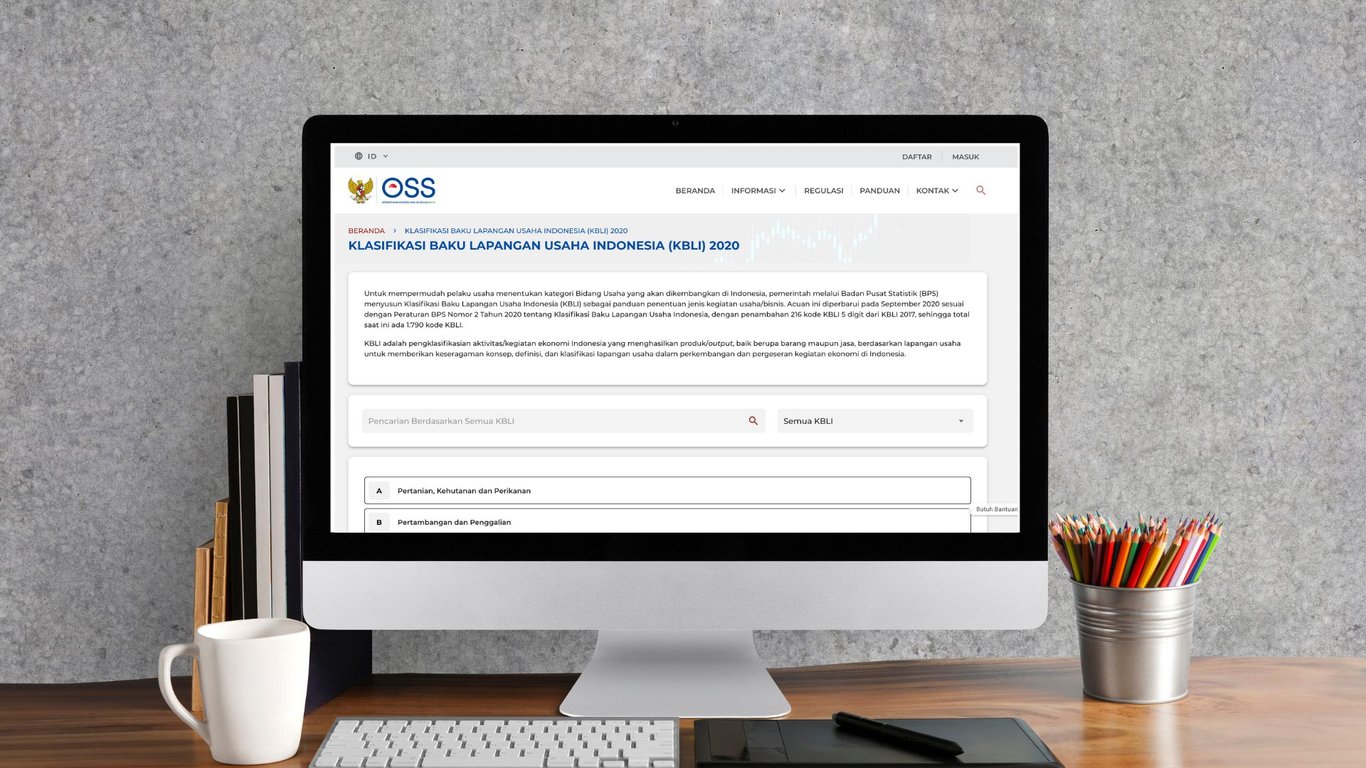

Indonesia has spent the past several years positioning itself as one of Asia’s most attractive destinations for foreign capital. Through reforms such as the Online Single Submission (OSS) system and the Positive Investment List under Presidential Regulation No. 10/2021, the government has pledged to reduce red tape and open more sectors to international investors.
Yet, despite these efforts, many foreign-owned companies (PT PMAs) still encounter delays, rejected applications, or unexpected capital requirements. The problem often lies not in the national policy headlines, but in the details: the KBLI (Klasifikasi Baku Lapangan Usaha Indonesia) codes that define business activities, and the local zoning rules that determine where those activities can take place.
At its core, the KBLI system is a classification framework that assigns five-digit codes to every business activity in Indonesia. When a foreign investor registers a PT PMA, these codes must be declared in the OSS system. On paper, this looks like a simple administrative step. In practice, it sets the legal boundaries for what a company can do.
A KBLI code is far more than a bureaucratic label—it sets the boundaries for how a company can legally operate in Indonesia. It determines the scope of business activities that are permitted, defines the licensing requirements under the OSS Risk-Based Approach (OSS-RBA) by categorizing activities as low, medium, or high risk, and dictates the extent to which foreign investors can participate, whether fully, partially, or not at all. In addition, KBLI codes are tied to investment commitments, with most PT PMAs required to declare a minimum investment plan of more than IDR 10 billion for each line of business per location, excluding land and buildings.
While these requirements already pose challenges for new investors, the impact of KBLI extends beyond national regulation into the realm of local compliance.
Indonesia’s effort to attract foreign capital often runs up against the country’s highly localized governance system. A KBLI code does not only dictate licensing; it must also align with regional spatial and zoning regulations.
A construction company registered under KBLI 41012, for example, cannot legally operate out of a residentially zoned office. Trading companies often require warehouse permits tied to specific zones. Even digital platforms that rely on logistics networks may face restrictions if their chosen KBLI conflicts with local land use rules.
This intersection of national and regional rules creates a dual compliance burden: a business may be fully approved under the OSS system but still unable to operate until its KBLI aligns with local zoning. The result is costly delays and, in some cases, stalled projects.
Foreign investors frequently underestimate the complexity of matching KBLI classifications with zoning rules. The most common pitfalls include:
– Overly broad business classifications — selecting codes that do not match the actual business model, triggering questions from local authorities.
– Mismatched documentation — inconsistencies across a company’s deed, OSS filing, and tax registration often lead to rejections.
– Ignoring zoning restrictions — assuming national approval guarantees local compliance.
– Capital shortfalls — failing to anticipate that multiple KBLIs from different sectors may each require an IDR 10 billion investment plan.
– Delayed updates — companies that pivot into new activities without updating their KBLI face licensing gaps and potential penalties.
These hurdles highlight a broader tension in Indonesia’s investment landscape. The government’s reforms aim to streamline procedures and reduce barriers, yet the persistence of zoning-related complications shows that the investment process is still fragmented.
For multinational groups, this creates both financial and reputational risk. Investors who fail to anticipate local compliance issues may be forced into costly restructuring, while others risk losing credibility with regulators and partners. In sectors where timing is critical—such as infrastructure or digital services—delays can erode competitive advantage.
At the same time, these challenges reveal Indonesia’s balancing act. By tying business classification to zoning and capital requirements, the state ensures that foreign entrants commit serious investment and align with urban planning priorities.
For companies unfamiliar with Indonesia’s regulatory ecosystem, the nuances of KBLI and zoning can be easy to miss. Local advisors and legal experts are increasingly vital in helping investors map their business models to the correct KBLI codes, cross-check them with the Positive Investment List, and ensure that facility locations comply with regional zoning plans.
As CPT Corporate observes, many delays in PT PMA registration stem not from government resistance to foreign capital, but from preventable mismatches between a company’s declared KBLI and its actual operations. Addressing these issues early—at the stage of company registration—can prevent months of delay and significant cost overruns.
Indonesia remains one of Southeast Asia’s most dynamic investment destinations, buoyed by demographic growth, infrastructure development, and a digital economy that is expanding at double-digit rates. But the friction between national reforms and local enforcement means that investors must go beyond headlines and pay attention to details.